The Manager as AI Conductor: 5 Responsibilities That Change Everything
AI does not eliminate the manager's role. It shifts it: less tool control, more orchestration of usage.
In many teams, AI is already here. One employee uses it to summarize a file. Another to prepare a delicate email. A third uses it discreetly, without knowing if they are allowed to.
Usage often moves faster than the collective framework. And it is the manager who finds themselves on the front line, with a question for which no one has truly prepared them:
How can these individual uses be turned into collective performance, without degrading quality, trust, or equity?
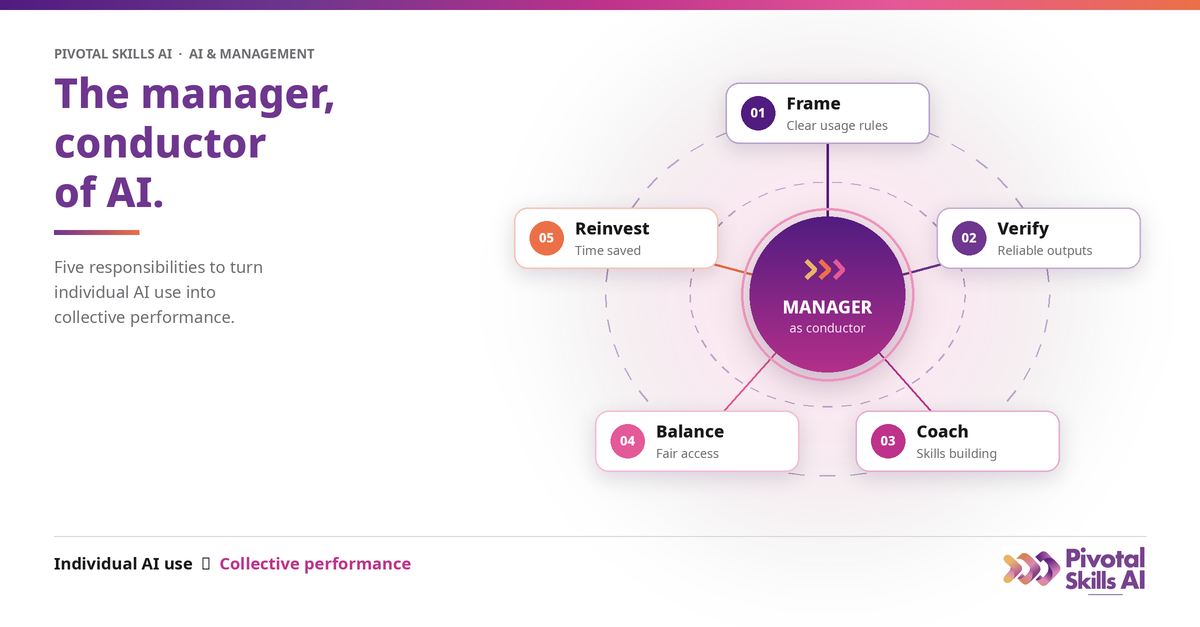
This article proposes a simple framework: five managerial responsibilities that, together, turn the manager into an AI conductor rather than a mere gatekeeper of tools.
Why the Manager's Role is Changing Now
Three reasons make this subject urgent.
1. AI is entering real work. It is no longer confined to data or innovation teams. It affects writing, analysis, decision preparation, customer relations, and support functions.
2. The regulatory framework is becoming clearer. The European AI Act is based on a risk-level approach. AI literacy obligations have applied since February 2, 2025: organizations deploying AI systems must ensure a sufficient level of mastery among the people using them. AI tools used for recruitment or worker management are among the use cases classified as high-risk. Finally, emotion recognition in the workplace is among the prohibited practices. [1]
3. Value comes from usage, not the tool. Two teams equipped with the same solution can achieve very different results. The gap lies in how they organize, verify, learn, and share.
The manager sits precisely at this intersection: between the company's strategic directions and the daily work of the teams.
From Control to Orchestration
The natural reflex when faced with a new technology is control: authorize, prohibit, monitor. This is useful, but insufficient.
A manager cannot check every prompt sent to an AI tool. Nor is it their job to become an expert in every model.
Instead, their role consists of creating the conditions for useful, reliable, and shared usage. This is the meaning of the conductor metaphor: they do not play every instrument, but they set the tempo, ensure harmony, and make sure everyone finds their place.
This orchestration rests on five responsibilities.
The Five Responsibilities of the Manager Facing AI
| Responsibility | Key Question | What the Manager Organizes | |---|---|---| | 1. Framing | What are we allowed to do? | Clear and proportionate usage rules | | 2. Verifying | Is the result reliable? | Quality criteria and validation levels | | 3. Supporting | Does everyone know how to use AI well? | Skill development adapted to specific roles | | 4. Balancing | Is everyone progressing? | Equity of access, information, and learning | | 5. Reinvesting | What happens to the time saved? | Transforming gains into collective value |
1. Framing: Clear Usage Rules
Faced with AI, two reactions are common: allow everything, or ban everything. Neither is satisfactory.
The risk-based approach of the European framework recalls a simple idea: not all uses require the same level of control. [1] Rewording an internal message does not involve the same stakes as analyzing personal data or preparing a decision concerning an employee.
For the manager, framing means translating principles into understandable rules in real-world situations:
- Which information must never be entered into an unvalidated tool;
- Which content must be proofread before distribution;
- Which decisions cannot rely on a generated response;
- Whom to notify in case of an error or doubt.
Regarding data protection, resources from the CNIL (French Data Protection Authority) provide a useful foundation for building these rules. [3]
Pitfall to watch for: A charter that is too long or too abstract will not be applied. Five understood rules are better than thirty ignored pages.
2. Verifying: Quality Cannot Be Delegated
AI produces quickly. But speed guarantees neither accuracy nor relevance.
The key skill is therefore not just "writing a good prompt." It is knowing how to evaluate a result:
- Does it truly meet the need?
- Is the information accurate and up to date?
- Is an important element missing?
- Can it be sent as is to a client or colleague?
The manager can instill this requirement by asking team members to share, along with the result, the checks performed and the limitations encountered. The goal is not to be suspicious, but to make quality criteria visible.
3. Supporting: Training Beyond the Prompt
Not all employees adopt AI at the same pace. Some experiment alone. Others wait for a framework. Still others fear losing their expertise.
A single training session for everyone is not enough. Effective support combines:
- Use cases linked to the specific job;
- Supervised practice time;
- Examples of acceptable and unacceptable results;
- Peer-to-peer exchanges;
- An explicit right to ask for help.
This is also the concrete response to the AI literacy obligation: it is not summarized by a single awareness session but implies mastery adapted to real-world uses. [1]
4. Balancing: Avoiding a Two-Speed AI
AI can bridge certain gaps. It can also create new ones.
A digitally-savvy employee will progress quickly. Another will remain at a distance, due to a lack of time, benchmarks, or confidence. Without attention, the team divides between those who "know how" and the others.
The manager must therefore observe:
- who is using AI, and for which tasks;
- who is hesitant to use it;
- which expertise remains concentrated among a few individuals;
- which errors are recurring.
The goal is not to impose the same usage on everyone. It is to guarantee everyone a sufficient level of access, information, and support.
5. Reinvesting: transforming time saved into value
Time saved is not yet value created. If it is not reinvested, it simply dilutes into more production.
The manager must explicitly ask the question: what are we doing with the freed-up time?
It can be used to:
- deepen analyses;
- improve customer relationships;
- handle postponed topics;
- document the team's expertise;
- develop new skills.
It is this decision, and not the tool itself, that transforms individual gains into collective performance.
Rituals that make orchestration concrete
These responsibilities take shape through a few simple rituals, to be adapted to each team:
- The monthly usage sharing: an employee presents a concrete case—problem, method, result, limitation.
- The quality review: the team collectively analyzes a result produced with AI and derives common criteria from it.
- The usage registry: a living list of use cases, classified by value, frequency, and risk level.
- The "reinvested time" check-in: a regular exchange to verify that gains are truly serving the team, customers, or the organization.
These rituals serve an essential function: transforming individual experimentation into collective learning.
Where to start? Three steps
- Observe. Identify existing usages, declared or not, team needs, and primary risks.
- Frame. Set a few common rules, choose two or three priority use cases, and specify validation levels.
- Learn and measure. Provide support, compare practices, measure effects, and then adjust.
Progress is not measured by the number of licenses or people trained. It is measured by the team's ability to produce higher quality work, with more autonomy and sufficient mastery.
To objectify this starting point and track progress, measuring skills and usage becomes a useful lever. This is the role of the Digital Skills Analyzer by Pivotal Skills AI: mapping AI maturity by employee or by team, targeting training actions, and tracking their impact. It does not replace managerial dialogue; it informs it.
What leaders need to remember
- The manager is the decisive link between the company's AI strategy and the actual work.
- They need a clear mandate, simple rules, and time to support their teams.
- Manager training must precede or accompany team training, not follow it.
- Measurement must focus on value created, not just adoption rates.
Conclusion: AI management is first and foremost work management
The manager does not need to know everything about artificial intelligence. They must understand how it transforms tasks, decisions, skills, and relationships within their team.
Framing, verifying, supporting, balancing, reinvesting: these five responsibilities define a role that is more demanding, but also more strategic. It is under this condition that AI becomes a lever for collective performance, rather than just another tool placed on top of unchanged processes.
At Pivotal Skills AI, we support organizations in this transformation through usage, skills, and the measurement of value created. Because the challenge is not to ask managers to master everything, but to give them the means to orchestrate.
And in your organization, which of these five responsibilities is currently the least covered?
Sources
- European Commission, AI Act — Shaping Europe’s digital future (risk-based approach, prohibited practices, high-risk use cases, implementation timeline including AI literacy obligations since February 2, 2025): https://digital-strategy.ec.europa.eu/en/policies/regulatory-framework-ai
- Regulation (EU) 2024/1689 laying down harmonised rules on artificial intelligence, EUR-Lex: https://eur-lex.europa.eu/legal-content/EN/TXT/?uri=CELEX%3A32024R1689
- CNIL, Artificial Intelligence — resources on usage, risks, and data protection: https://www.cnil.fr/en/artificial-intelligence
The five responsibilities, rituals, and the three-step approach constitute a model proposed by Pivotal Skills AI. They are based on analysis and recommendations, rather than a statistical study.