
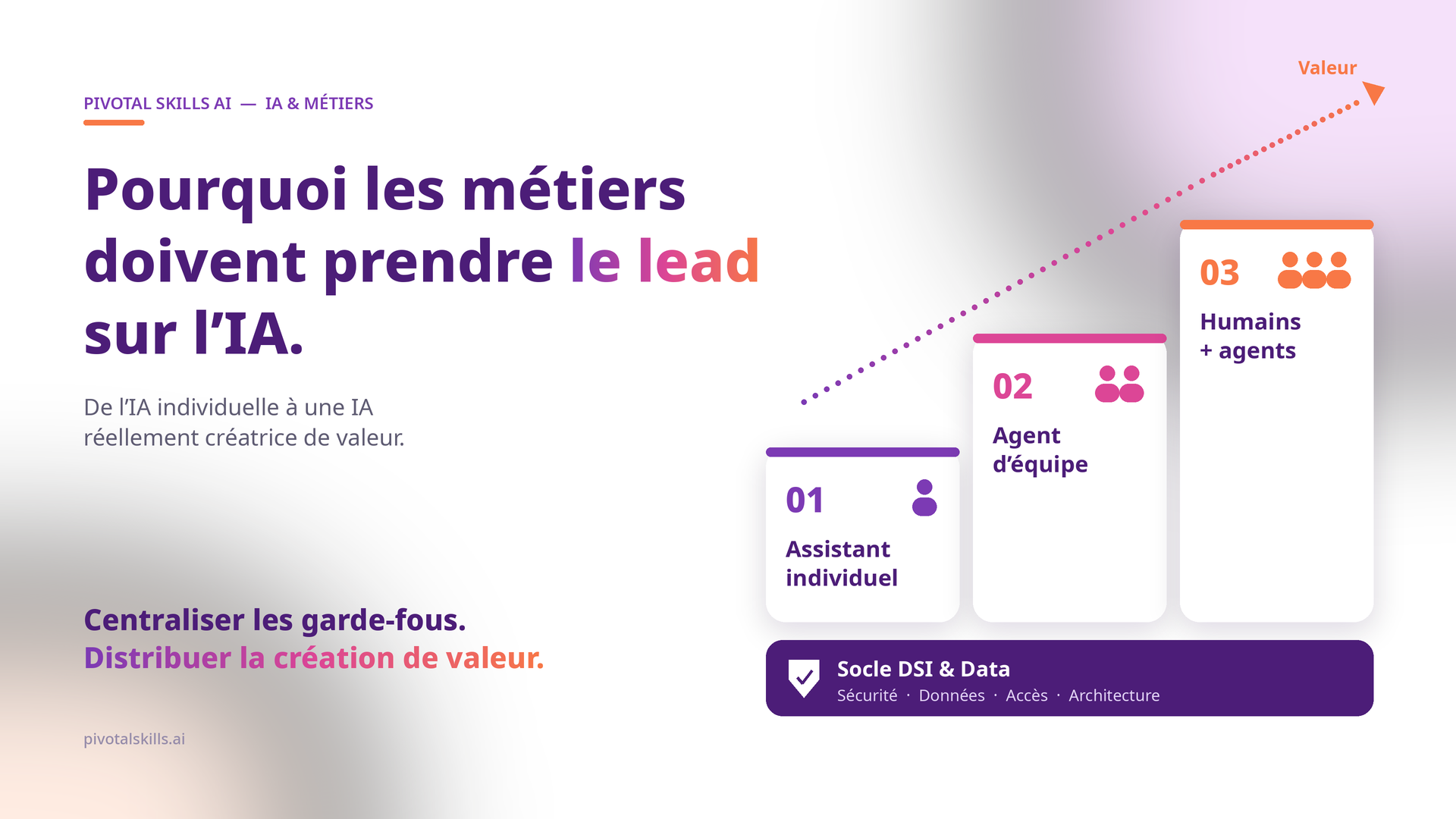
Why Business Units Must Take the Lead on AI
To move from individual AI to AI that truly creates value, business departments must drive use cases, with the IT department acting as the guarantor of the framework, security, and scalability.
In many companies, we still see the same scenario: the IT or Data department launches an AI platform, distributes licenses, organizes a few training sessions, and then waits for usage to develop.
Employees do indeed start using AI. They write faster, summarize documents, prepare for meetings, or analyze data.
But the processes themselves change very little.
The problem is not necessarily the tool. It is often the way the company organizes its deployment.
The real issue is no longer adoption, but value
AI is already widely used individually. According to McKinsey, 80% of respondents say it improves their personal productivity. Yet, only 37% attribute a positive impact on their organization's EBIT to AI.
This gap is essential.
An employee can save twenty minutes on a task without it automatically producing a measurable gain for the company. To create value at scale, processes must be reviewed, the right tools must be connected to the right data, and work must be organized differently.
In other words:
The problem is no longer providing access to AI. The problem is transforming individual gains into collective performance.
And a central team cannot do this alone.
A central team never knows the full reality of the work
The IT department knows the systems, architectures, security constraints, and available data. This is indispensable.
But it does not always know the small workarounds, exceptions, trade-offs, and pain points that make up the daily life of a business team.
A sales department, an HR team, a quality department, or a customer relationship center knows exactly where time is wasted and where costly errors occur. They also know what a truly useful response looks like, versus what is merely a technological demonstration.
An IT department can secure an agent. It cannot always decide, on behalf of a team, which step of their work deserves to be transformed as a priority.
The further an agent is from those doing the work, the more it risks optimizing the theoretical process rather than the actual process.
This is why business units must take the lead on use cases, priorities, and expected results.
Taking the lead does not mean bypassing IT
It is obviously not about letting each team choose its own tools, connect any data, and publish agents without control.
The IT department must continue to guarantee:
- security;
- access rights;
- data quality;
- architecture;
- compliance;
- cost control;
- production deployment conditions.
But business units must be responsible for another part of the subject:
- the problem to be solved;
- the process to be improved;
- quality criteria;
- the users involved;
- the expected gain;
- the evolutions to be made to the agent.
The right question is therefore not: "Who should own the AI?"
The right question is:
Who owns the result that the AI is supposed to improve?
If a business department is responsible for processing times, conversion rates, customer satisfaction, or process quality, it must be able to participate directly in the design and improvement of the agent acting on these indicators.
The right model: centralize safeguards, distribute value creation
The most effective model is neither fully centralized nor fully decentralized.
McKinsey observes that AI adoption is often organized according to a hybrid model, combining central resources and distributed capabilities within functions.
Concretely, this means:
- IT defines the framework;
- the Data department secures the data;
- Legal helps qualify risks;
- business units identify opportunities;
- teams test agents on real cases;
- managers organize new ways of working.
The role of the IT department then evolves. It is no longer forced to produce or validate every agent like a classic IT project. It becomes the architect of the system, the guarantor of the rules, and the accelerator of the transformation.
Business units, for their part, do not become AI engineers. They learn to formalize a need, describe a process, define a quality requirement, test an agent, and request the right improvements.
An agent is not just a prompt
An important agent must be treated as a business product.
It must have a clear objective, identified users, authorized data, an owner, evaluation criteria, and an update procedure.
Without this, we end up with agents that look alike, are no longer maintained, or for which no one really knows who is responsible.
Every agent should therefore have a business owner capable of answering five questions:
- What is it for?
- Who was it created for?
- How do we measure its quality?
- Who decides on its evolutions?
- When should it be modified or retired?
This responsibility is essential because the value of an agent does not come only from its first version. It comes from its ability to improve through contact with real work.
The central role of managers
Managers will also have a new role to play.
They must not simply encourage their teams to use AI. They must help them rethink the way they work.
Which tasks can be delegated to an agent? Which decisions must remain human? How do we control quality? What do we do with the time freed up? Which skills need to be developed?
These questions fall directly under the scope of management.
Microsoft's 2026 research attributes 67% of the reported impact of AI to organizational factors—such as culture, manager support, and skill development practices—compared to 32% for individual factors. Above all, this study shows one thing: AI produces more significant effects when the organization creates the conditions for its use.
The manager thus becomes the designer of a new work collective, composed of employees, agents, and control rules.
From Individual AI to Collaborative Agentic AI
The individual conversational assistant is a useful first step. However, it often remains dependent on the motivation and skill level of each user.
The next step consists of creating shared agents, connected to the right sources and integrated into processes.
An agent can then prepare a file, verify information, query a document database, propose a response, or hand off a task to another agent. Employees retain responsibility for important decisions, but they possess a much broader capacity for action.
This is the transition from AI used by individuals to collaborative agentic AI, integrated into the team's operations.
A Simple Rule to Get Started
To begin, it is not necessary to launch a major transformation program.
Simply choose a concrete process, appoint a business owner, involve the IT department from the start, and measure the current situation before creating the agent.
Then, the team can test an initial version on real cases, observe errors, collect feedback, and progressively improve the solution.
This approach avoids two pitfalls: pilot projects that lead nowhere and large-scale projects that are too disconnected from users.
The next stage of AI in the enterprise is therefore not simply about giving an assistant to everyone.
It is about enabling teams to build and improve their own tools, within a framework that is secure enough to avoid deviations, but flexible enough to let good ideas emerge.
IT must secure AI. Business units must make it useful.
It is likely this new balance that will allow the shift from individual, conversational AI—which is difficult to measure—to AI that is truly integrated into processes and capable of transforming the organization.
Sources
- McKinsey & Company, The State of AI (2025 and 2026 editions): mckinsey.com/capabilities/quantumblack/our-insights/the-state-of-ai
- Microsoft, Work Trend Index 2026: Agents, human agency, and the opportunity for every organization: microsoft.com/en-us/worklab/work-trend-index