Until recently, a company could measure its progress in artificial intelligence with a relatively simple question:
How many employees are using AI?
In 2026, this question is no longer enough.
One employee might use a generative assistant daily to rephrase three emails. Another might integrate it into a business process that saves several hours per week. On an adoption dashboard, they both appear as "active users."
For the company, however, their impact is not comparable.
This is likely where the next challenge for leaders lies: moving from measuring adoption to measuring value.
AI becomes an organizational matter
Work by Bpifrance Le Lab on French SMEs and mid-caps illustrates an interesting situation: leaders have largely identified the strategic nature of AI, but its deployment and appropriation remain highly operational issues.
The study is based on a survey of 1,209 leaders, supplemented by interviews with executives and experts.
Consult the Bpifrance Le Lab study
In other words, the question is gradually shifting from:
Should we move toward AI?
To:
How do we transform these use cases into a collective capability?
This nuance changes everything. Buying a license is easy to measure. Developing a skill is less so, and creating sustainable value is even less so.
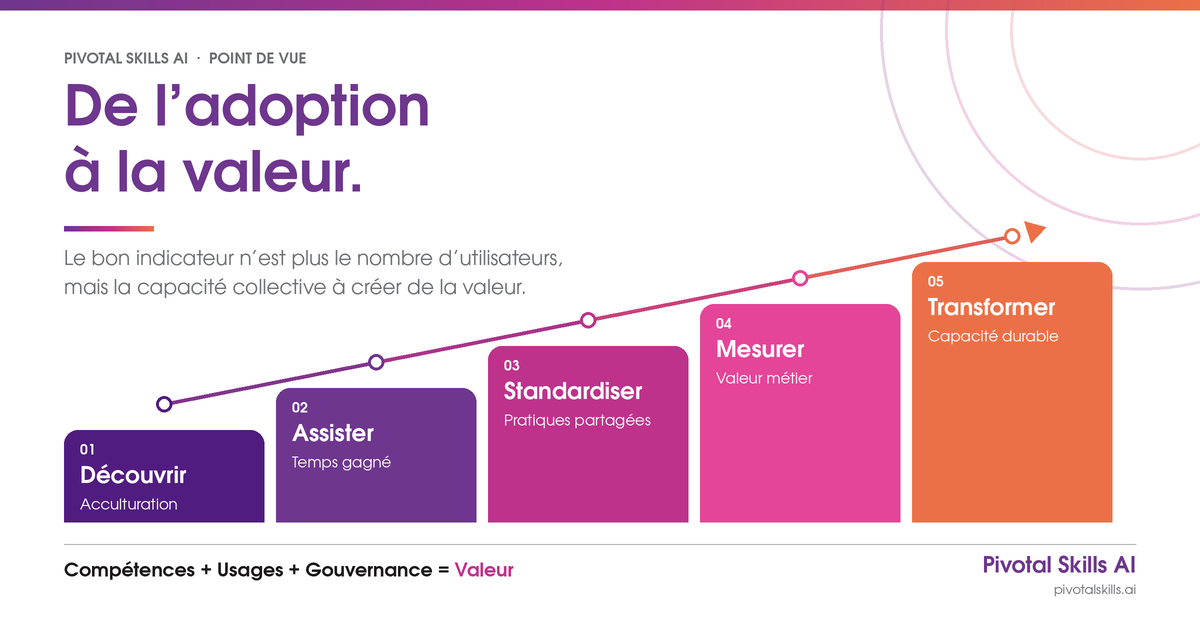
Five levels to view AI maturity differently
I propose a deliberately simple framework.
Level 1: Discovering
Employees are testing the tools. They ask an AI to summarize a document, prepare an email, generate a few ideas, or structure a presentation.
- Value: learning and acculturation.
- Limitation: lots of experimentation, little measurement.
Level 2: Assisting
AI begins to be integrated into recurring professional tasks: preparing for a sales meeting, analyzing a document, synthesizing a meeting, or creating a first draft of a deliverable.
- Value: time saved and improved work comfort.
- Key question: is this gain real and reproducible?
Level 3: Standardizing
Certain use cases become collective. The company identifies practices that work, documents them, and scales them.
We are no longer just talking about "AI best practices," but concrete processes:
- Which task?
- Which tool?
- Which data?
- Which human oversight?
- What is the expected result?
It is often at this stage that AI proficiency truly begins to become an organizational competency.
Level 4: Measuring
This is arguably the most important level.
An organization should be able to reconcile several indicators:
- frequency of use;
- level of autonomy;
- time saved;
- quality produced;
- cost of solutions;
- skills mobilized;
- identified risks;
- business value obtained.
The relevant KPI is therefore no longer just the number of active licenses.
It is, for example:
In this sales process, 40 employees use AI. For what results and at what cost?
Level 5: Transforming
The company no longer seeks solely to perform an existing task faster. It redesigns the process itself.
At this stage, automations and agents capable of chaining several operations may appear, under appropriate human control mechanisms.
The leader's question changes again:
If part of this process can be performed differently thanks to AI, how must we rethink roles, skills, and organization?
Governance now meets competency
This reflection is not solely related to productivity.
The European Artificial Intelligence Act introduces a risk-based approach. It also mandates AI literacy obligations, applicable since February 2, 2025.
The European Commission also notes that the regulation became applicable on August 2, 2026, with specific timelines for certain provisions.
This creates a particularly interesting alignment between three subjects long managed separately:
Skills + Usage + Governance
Training employees without understanding their actual practices is becoming insufficient. Governing tools without understanding usage is equally so. Measuring usage without measuring value does not allow for steering a transformation.
We must therefore change the dashboard
Imagine two departments of 100 people. In the first, 70 people regularly use an AI assistant. In the second, only 35 do.
Is the first necessarily twice as mature?
We need to know:
- the tasks performed;
- the autonomy acquired;
- the quality of results;
- the risks;
- the time actually saved;
- how these gains are reinvested.
This is exactly why we work at Pivotal Skills AI on the simultaneous measurement of skills, usage, and real impact.
The Digital Skills Analyzer can serve a precise function here: helping to establish an initial snapshot, then observing progress by employee, team, use case, or project.
The goal is not to add yet another dashboard, but to enable a decision:
What should we develop? What should we standardize? What should we stop? And where should we invest more?
The real asset may not be the tool
AI tools will continue to evolve rapidly. The model used today will not necessarily be the one used tomorrow.
On the other hand, an organization capable of:
- identifying a use case;
- testing it quickly;
- measuring its impact;
- managing its risks;
- developing the necessary skills;
- and then deciding whether or not to industrialize it;
... possesses a much more sustainable asset:
A collective capacity to transform AI into value.
And perhaps this is what companies should start measuring.
Sources
- Bpifrance Le Lab, "AI in French SMEs and Mid-caps", survey of 1,209 SME and mid-cap executives.
- European Commission, European Artificial Intelligence Act, risk-based approach, implementation timeline, and obligations regarding AI literacy.