
Back to news
AI adoption
AI maturity
AI adoption levels
AI transformation

From ChatGPT to the "Wow" Effect: The 5 Levels of AI Adoption That Actually Create Value ## Introduction The hype around artificial intelligence is everywhere, but behind the headlines, a fundamental question remains for businesses: **how do you turn a technical tool into a real engine for growth?** Adopting AI is not a binary process (having it or not having it). It is a journey. Based on our observations with dozens of organizations, we have identified **5 levels of maturity**. Each level represents an increase in complexity, but above all, a significant leap in value creation. --- ## Level 1: Individual Experimentation (Shadow AI) This is the "ChatGPT in a browser tab" stage. Employees use AI tools on their own initiative to draft emails, summarize long documents, or debug code. - **Value:** Immediate individual productivity gain. - **Risk:** Data security (leaking sensitive information) and a lack of shared methodology. - **The "Waouh" effect:** Low. It is perceived as a personal "gadget" rather than a corporate asset. ## Level 2: The Integrated Professional Toolbox The company formalizes its use. It provides secure tools (Enterprise versions of LLMs) and starts training its teams in **Prompt Engineering**. - **Value:** Risk mitigation and standardization of basic tasks. - **Action:** Implementing a charter for responsible use and deploying specialized assistants for specific departments (Marketing, HR, Legal). - **The "Waouh" effect:** Moderate. Efficiency is visible, but the business model remains unchanged. ## Level 3: Contextualization and RAG (Retrieval-Augmented Generation) This is a major turning point. The AI no longer just speaks from its general knowledge; it feeds on **the company's internal data**. By using RAG (Retrieval-Augmented Generation) architectures, the AI can answer questions based on internal procedures, technical documentation, or sales history. - **Value:** Extreme relevance. The AI becomes an "augmented expert" that knows the company's specific DNA. - **Technical Challenge:** Data quality and structuring. - **The "Waouh" effect:** High. Employees feel they have a brilliant colleague who has read every archive in the company. ## Level 4: Business Process Re-engineering (Agentic AI) We move beyond simple "chat." The AI is integrated into workflows via **autonomous agents**. It doesn't just suggest; it *does*. For example, an agent can receive a customer complaint, check the status of an order in the ERP, draft a personalized response, and trigger a refund automatically. - **Value:** Massive operational scalability. Teams shift from execution to supervision. - **Focus:** Integration with existing APIs and software ecosystems. - **The "Waouh" effect:** Very high. This is where the ROI becomes spectacular. ## Level 5: AI-Native Innovation and New Business Models At this ultimate level, AI is no longer a support tool; it is the core of the value proposition. The company develops products or services that would be impossible without AI (hyper-personalization at scale, predictive maintenance as a service, automated creative design). - **Value:** Sustainable competitive advantage and disruption of the market. - **Mindset:** Total cultural transformation where every problem is approached through the lens of data and automation. - **The "Waouh" effect:** Total. This is the stage of market leaders. --- ## Conclusion: Where do you stand? Most companies are currently oscillating between Level 1 and Level 2. The real challenge for 2024 and 2025 is to cross the chasm toward **Level 3 (Contextualization)** to stop just "playing" with AI and start capitalizing on their own data. **The journey to the "Wow" effect isn't a sprint, but a deliberate ascent. At which level will you start your next quarter?**

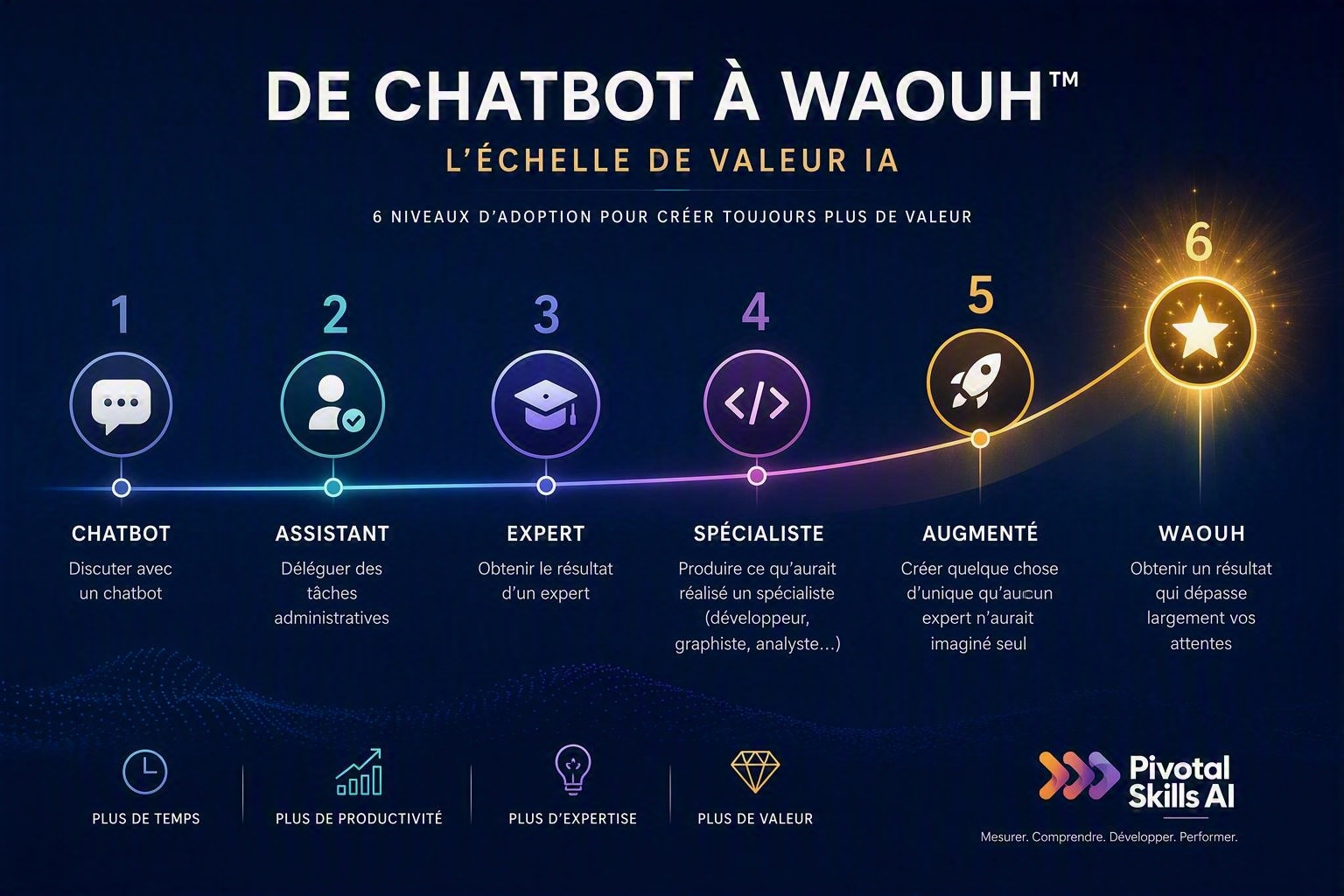
During a recent conversation with an executive, one simple reflection stuck with me. For him, AI adoption is not measured by the number of ChatGPT or Copilot licenses deployed. It is measured by the level of usage maturity. ➡️ Level 1: Chatting with a chatbot. ➡️ Level 2: Delegating administrative tasks to an assistant. ➡️ Level 3: Obtaining the output of an expert. ➡️ Level 4: Producing what a specialist (developer, graphic designer, analyst...) would have created. ➡️ Level 5: Creating something unique that no expert would have imagined alone. And perhaps an ultimate level: the famous "Wow" effect. That moment when AI produces a result that far exceeds what you hoped to achieve. The real question, therefore, is perhaps not "Are we using AI?" but rather: At what level of adoption are we actually?

From ChatGPT to the "Wow" Effect: The 5 Levels of AI Adoption That Actually Create Value

## Introduction

The hype around artificial intelligence is everywhere, but behind the headlines, a fundamental question remains for businesses: **how do you turn a technical tool into a real engine for growth?**

Adopting AI is not a binary process (having it or not having it). It is a journey. Based on our observations with dozens of organizations, we have identified **5 levels of maturity**. Each level represents an increase in complexity, but above all, a significant leap in value creation.

---

## Level 1: Individual Experimentation (Shadow AI)

This is the "ChatGPT in a browser tab" stage. Employees use AI tools on their own initiative to draft emails, summarize long documents, or debug code.

- **Value:** Immediate individual productivity gain.
- **Risk:** Data security (leaking sensitive information) and a lack of shared methodology.
- **The "Waouh" effect:** Low. It is perceived as a personal "gadget" rather than a corporate asset.

## Level 2: The Integrated Professional Toolbox

The company formalizes its use. It provides secure tools (Enterprise versions of LLMs) and starts training its teams in **Prompt Engineering**.

- **Value:** Risk mitigation and standardization of basic tasks.
- **Action:** Implementing a charter for responsible use and deploying specialized assistants for specific departments (Marketing, HR, Legal).
- **The "Waouh" effect:** Moderate. Efficiency is visible, but the business model remains unchanged.

## Level 3: Contextualization and RAG (Retrieval-Augmented Generation)

This is a major turning point. The AI no longer just speaks from its general knowledge; it feeds on **the company's internal data**. By using RAG (Retrieval-Augmented Generation) architectures, the AI can answer questions based on internal procedures, technical documentation, or sales history.

- **Value:** Extreme relevance. The AI becomes an "augmented expert" that knows the company's specific DNA.
- **Technical Challenge:** Data quality and structuring.
- **The "Waouh" effect:** High. Employees feel they have a brilliant colleague who has read every archive in the company.

## Level 4: Business Process Re-engineering (Agentic AI)

We move beyond simple "chat." The AI is integrated into workflows via **autonomous agents**. It doesn't just suggest; it *does*. For example, an agent can receive a customer complaint, check the status of an order in the ERP, draft a personalized response, and trigger a refund automatically.

- **Value:** Massive operational scalability. Teams shift from execution to supervision.
- **Focus:** Integration with existing APIs and software ecosystems.
- **The "Waouh" effect:** Very high. This is where the ROI becomes spectacular.

## Level 5: AI-Native Innovation and New Business Models

At this ultimate level, AI is no longer a support tool; it is the core of the value proposition. The company develops products or services that would be impossible without AI (hyper-personalization at scale, predictive maintenance as a service, automated creative design).

- **Value:** Sustainable competitive advantage and disruption of the market.
- **Mindset:** Total cultural transformation where every problem is approached through the lens of data and automation.
- **The "Waouh" effect:** Total. This is the stage of market leaders.

---

## Conclusion: Where do you stand?

Most companies are currently oscillating between Level 1 and Level 2. The real challenge for 2024 and 2025 is to cross the chasm toward **Level 3 (Contextualization)** to stop just "playing" with AI and start capitalizing on their own data.

**The journey to the "Wow" effect isn't a sprint, but a deliberate ascent. At which level will you start your next quarter?**

Les 5 niveaux d’adoption de l’IA décrivent la progression des usages, allant du simple chatbot (Niveau 1) à l'intelligence augmentée (Niveau 5) et à l'effet "Waouh !" (Niveau 6). Cette échelle permet aux entreprises d'optimiser la création de valeur, comme l'amélioration de la productivité individuelle au Niveau 2, réduisant les tâches administratives jusqu'à 30%.

From ChatGPT to the "Wow" Effect: The 5 Levels of AI Adoption That Actually Create Value

During a recent conversation with the CEO of a company undergoing digital transformation, a simple but particularly relevant insight caught our attention.

According to him, the question is no longer whether the company uses AI, but how far it is capable of taking it.

We found this vision interesting because it moves beyond the usual technological debate to focus on what truly matters: value creation.

Throughout the discussion, he described what he considers the different levels of maturity in the use of artificial intelligence.

We have chosen to formalize this reflection in the form of an AI Value Scale, a simple model to evaluate the progression of use cases and the value created by AI within the company.


Why measure maturity rather than adoption?

Today, many organizations measure:

  • The number of licenses deployed
  • The number of active users
  • The volume of interactions with AI tools

These indicators are useful.

But they say nothing about the value actually produced.

Using ChatGPT once a day does not mean you are transforming your work.

The real question is therefore:

At what level of AI maturity are your employees?


Level 1: The Chatbot

💬 AI as an interlocutor

This is the level where a large portion of users still reside.

AI is used to:

  • Ask questions
  • Obtain information
  • Generate a few ideas
  • Conduct minor research

Value created

✅ Fast access to information

✅ Improved comfort

✅ Initial use cases

Main limitation

⚠️ The work is still primarily performed by the user.


Level 2: The Assistant

🤝 AI as a task executor

The first stage of value creation appears when one begins to entrust tasks to the AI.

For example:

  • Summarizing a document
  • Drafting an email
  • Producing meeting minutes
  • Preparing for a meeting
  • Comparing multiple documents
  • Structuring a presentation

Value created

✅ Time savings

✅ Reduction of administrative tasks

✅ Immediate individual productivity

The user stops merely conversing with the AI and starts delegating work to it.


Level 3: The Expert

🎓 AI as a business specialist

At this stage, the user is no longer just looking to save time.

They are looking to obtain a result equivalent to what an expert could have produced.

For example:

  • Strategic analysis
  • Marketing study
  • HR recommendations
  • Legal synthesis
  • Financial analysis

Value created

✅ Broadened access to expertise

✅ Accelerated skill development

✅ Improved decision quality

AI democratizes a portion of the expertise previously reserved for certain specialists.


Level 4: The Specialist

⚙️ AI as a solution producer

At this level, the user becomes capable of producing outputs that previously required highly specialized skills.

For example:

  • Developing an application
  • Creating an automated workflow
  • Designing an AI agent
  • Producing professional visuals
  • Creating a service prototype
  • Generating code

Value created

✅ Reduction of technical barriers

✅ Accelerated execution

✅ Lower production costs

The user is no longer systematically dependent on a technical expert to bring their ideas to life.


Level 5: Augmented Intelligence

🚀 AI as a thinking partner

Here we enter a new dimension.

The goal is no longer simply to obtain what an expert would have produced.

The goal is to obtain an answer or a solution that no expert would likely have imagined alone.

The AI combines:

  • The company context
  • Available data
  • Business knowledge
  • Best practices observed elsewhere
  • Multidisciplinary perspectives

Value created

✅ Innovation

✅ Creativity

✅ New mental models

✅ New opportunities

AI ceases to be a simple production tool to become a reflection amplifier.


Level 6: The Wow Effect

✨ AI exceeds expectations

This is probably the hardest level to describe.

And yet, many have already experienced it.

You are interacting with the AI.

You gradually enrich the context.

You refine your expectations.

And suddenly, the result produced far exceeds what you imagined possible.

You get:

  • An unexpected idea
  • An elegant solution
  • A remarkable analysis
  • A proposal you would never have formulated yourself

Value created

✅ Positive surprise

✅ Creative breakthrough

✅ Differentiation

✅ Transformation

At this stage, the AI no longer simply responds to a request. It triggers a shift in perspective.


The AI Value Scale™ at a glance

| Level | Role of AI | Value Created | |----------|----------|----------| | 💬 1 | Chatbot | Information | | 🤝 2 | Assistant | Productivity | | 🎓 3 | Expert | Expertise | | ⚙️ 4 | Specialist | Execution | | 🚀 5 | Augmented Intelligence | Innovation | | ✨ 6 | Wow Effect | Transformation |


What this changes for leaders

This approach seems particularly relevant because it shifts the debate.

The question is no longer:

"Are we using AI?"

But rather:

"How far are our employees capable of creating value with AI?"

An organization whose usage remains at level 1 or 2 will mainly see productivity gains.

An organization capable of reaching levels 4, 5, or 6 will begin to generate:

  • New operational capabilities
  • New services
  • New sources of innovation
  • A genuine competitive advantage

Conclusion

Artificial intelligence is not a destination.

It is a progression journey.

A journey that often begins with a simple conversation with a chatbot and can lead, step by step, to results we would never have imagined achieving alone.

The question for organizations is therefore perhaps no longer "Should we adopt AI?"

But rather: "How can we help our employees progress up the AI Value Scale?"

This is likely where the difference is made today between companies that experiment with AI... and those that derive a sustainable competitive advantage from it.


About Pivotal Skills AI

At Pivotal Skills AI, we support organizations in measuring and accelerating the adoption of artificial intelligence.

Through the Digital Skills Analyzer (DSA), we help leaders identify:

  • Real levels of AI maturity
  • Value-creating use cases
  • Barriers to adoption
  • Upskilling opportunities

Because before transforming your business with AI, you must first understand where you stand on the scale.

Frequently asked questions

Quels sont les cinq niveaux principaux d'adoption de l'IA ?

Les cinq niveaux principaux d'adoption de l'IA sont : le Chatbot (Niveau 1), l'Assistant (Niveau 2), l'Expert (Niveau 3), le Spécialiste (Niveau 4) et l'Intelligence Augmentée (Niveau 5), avec un niveau ultime d'« Effet Waouh ».

Comment le niveau 2 (Assistant) crée-t-il de la valeur pour une entreprise ?

Au niveau 2, l'IA agit comme un assistant, déléguant des tâches administratives telles que la rédaction d'e-mails ou la synthèse de documents. Cela génère un gain de temps immédiat et une réduction des tâches répétitives, améliorant la productivité individuelle des collaborateurs.

Quelle est la différence entre l'IA comme Expert (Niveau 3) et l'IA comme Spécialiste (Niveau 4) ?

Au Niveau 3 (Expert), l'IA fournit des analyses et recommandations (ex: stratégie, marketing), démocratisant l'expertise. Au Niveau 4 (Spécialiste), l'IA produit des réalisations complexes (ex: développer une application, générer du code) qui nécessitaient auparavant des compétences techniques spécifiques.

Comment l'Intelligence Augmentée (Niveau 5) favorise-t-elle l'innovation ?

Au Niveau 5, l'IA devient un partenaire de réflexion, combinant des données contextuelles et des connaissances métiers pour générer des solutions ou des idées qu'aucun expert n'aurait imaginées seul. Ce niveau est un puissant moteur d'innovation et de créativité.

Pourquoi est-il important de mesurer la maturité de l'IA plutôt que le nombre de licences ?

Mesurer la maturité de l'IA, via l'Échelle de Valeur IA, permet d'évaluer la valeur réelle créée. Le nombre de licences ou d'utilisateurs ne reflète pas si l'IA est utilisée pour de simples requêtes ou pour transformer des processus et générer un avantage concurrentiel significatif.