Will the Future Manager Be an AI Agent Coach?
"The companies that will derive the most value from artificial intelligence will not necessarily be those with the best tools, but those that know how to effectively organize collaboration between humans and artificial intelligence."
For decades, the manager's role was based on three main missions: setting a direction, coordinating activities, and developing team skills.
This definition remains valid.
But the arrival of AI agents could profoundly change how these responsibilities are exercised.
After the wave of conversational assistants, a new stage is gradually opening: that of agents capable of executing tasks, interacting with multiple applications, analyzing information, and performing certain actions semi-autonomously.
We are no longer just facing tools.
We are beginning to work with true digital collaborators.
In this context, a strategic question emerges:
Will the manager of tomorrow have to become an AI agent coach?
Management Enters a New Phase
For a long time, management consisted primarily of distributing work among team members.
The manager decided:
- who does what;
- how priorities are defined;
- how performance is evaluated;
- how skills are developed.
The arrival of AI is gradually changing this equation.
Certain activities currently performed by employees can already be partially automated:
- information research;
- document synthesis;
- content writing;
- data analysis;
- meeting preparation;
- report creation;
- decision support.
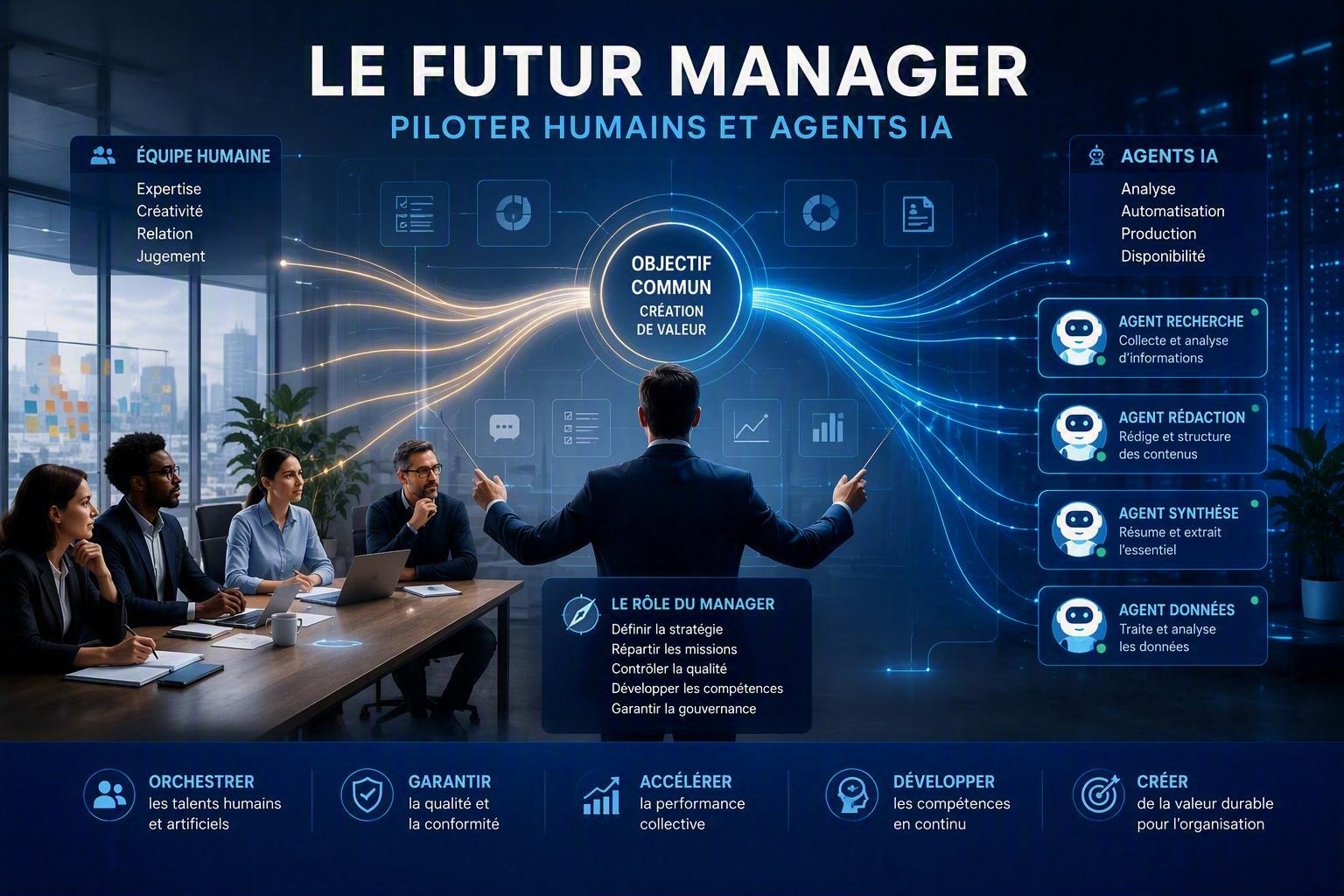
Tomorrow, many managers will have several specialized agents at their disposal capable of intervening in different business processes.
The question is then no longer just about delegating to people.
It is about knowing how to intelligently distribute work between humans and agents.
The Manager Becomes an Orchestrator
The most visible evolution probably concerns work coordination.
Until now, the manager primarily managed human resources.
Tomorrow, they will also have to manage digital cognitive resources.
Take a simple example.
To prepare a response to a request for proposal (RFP), a manager could mobilize:
- an agent responsible for collecting information;
- an agent responsible for analyzing client requirements;
- an agent responsible for producing an initial proposal;
- a human team responsible for validating, enriching, and personalizing the response.
The manager's role does not disappear.
It changes in nature.
Their work consists more of designing the collaboration system than controlling every micro-task.
The Key Skill: Knowing How to Distribute Responsibilities
One frequent mistake is thinking that it will be enough to simply give more work to AIs.
In reality, value appears when everyone intervenes where they are most effective.
Humans retain decisive advantages:
- strategic thinking;
- relational intelligence;
- complex arbitration;
- disruptive creativity;
- uncertainty management;
- responsibility for decisions.
AI agents, for their part, bring:
- speed of execution;
- processing capacity;
- permanent availability;
- standardization;
- automation.
The manager will have to learn to build this balance.
This is likely one of the major managerial skills of the coming years.
Managing Agents Does Not Look Like Managing People
An AI agent has neither motivation, nor emotions, nor professional aspirations.
Yet, it also requires support.
A poorly configured agent quickly produces:
- errors;
- irrelevant results;
- biases;
- time loss;
- a degradation of trust.
The manager's role then evolves toward several new activities:
Defining Missions
As with an employee, the quality of the result largely depends on the clarity of the objectives.
Quality Control
Generated outputs must be reviewed, corrected, and validated.
Evolving Usage
Agents progress when processes are adjusted and improved continuously.
Ensuring Compliance
Security, data, and governance issues become central.
Management does not disappear.
It extends to a new work environment.
Skills That Are Becoming Strategic
Paradoxically, the more AI progresses, the more certain human skills become important.
Critical Thinking
Agents can quickly produce convincing answers.
One must still be able to evaluate their quality.
Judgment
No AI today bears the responsibility for a strategic decision.
This responsibility remains human.
Pedagogy
Teams will need to be supported in adopting new practices.
Change Management
Many transformations fail less for technical reasons than for organizational ones.
The Culture of Experimentation
The organizations that progress the fastest will be those that learn the fastest.
The manager's role will therefore be to encourage testing, feedback, and continuous improvement.
The Risk: Investing in Tools Without Preparing Managers
Many companies are currently investing in AI licenses, platforms, and infrastructure.
This is necessary.
But insufficient.
Experience consistently shows that success depends more on:
- use cases;
- skills;
- governance;
- support and change management;
- impact measurement.
Without these dimensions, adoption remains low and the value created remains limited.
Technology alone does not transform an organization.
Behaviors do.
What Leaders Should Do Right Now
Faced with this evolution, several questions deserve to be asked.
1. Are managers trained in the real-world uses of AI?
Knowing the tool is no longer enough.
One must understand how to integrate it into daily activities.
2. Do you know how to measure adoption?
One of the main challenges consists of distinguishing one-off experiments from truly transformative uses.
3. Have you identified new managerial skills?
Managing hybrid teams will progressively become a strategic skill.
4. Is your AI governance clear?
The more autonomous agents become, the more important the issues of accountability and responsibility become.
Toward a New Leadership Model
The history of management is marked by several major transitions.
The Industrial Revolution transformed the organization of work.
The digital revolution transformed access to information.
Artificial intelligence is now transforming the production of knowledge.
In this context, the manager could progressively become less of a supervisor and more of an orchestrator.
Their role will no longer be just to obtain results.
They will need to create the conditions for effective collaboration between human and artificial intelligences.
This is likely where a significant portion of organizational competitiveness will be determined in the coming years.
The Conviction of Pivotal Skills AI
At Pivotal Skills AI, we observe that the most advanced organizations are not necessarily those that deploy the most tools.
They are often those that invest simultaneously in:
- skills;
- use cases;
- governance;
- impact measurement;
- manager support.
The future of management is not about replacing humans.
It is about enabling teams and AI agents to produce more value together.
And it starts with a simple question:
Are your managers already prepared to lead hybrid teams composed of humans and AI agents?
Sources
- European Commission, AI Act.
- OECD, Artificial Intelligence and the Future of Skills.
- Microsoft Work Trend Index.
- World Economic Forum, Future of Jobs Report.