
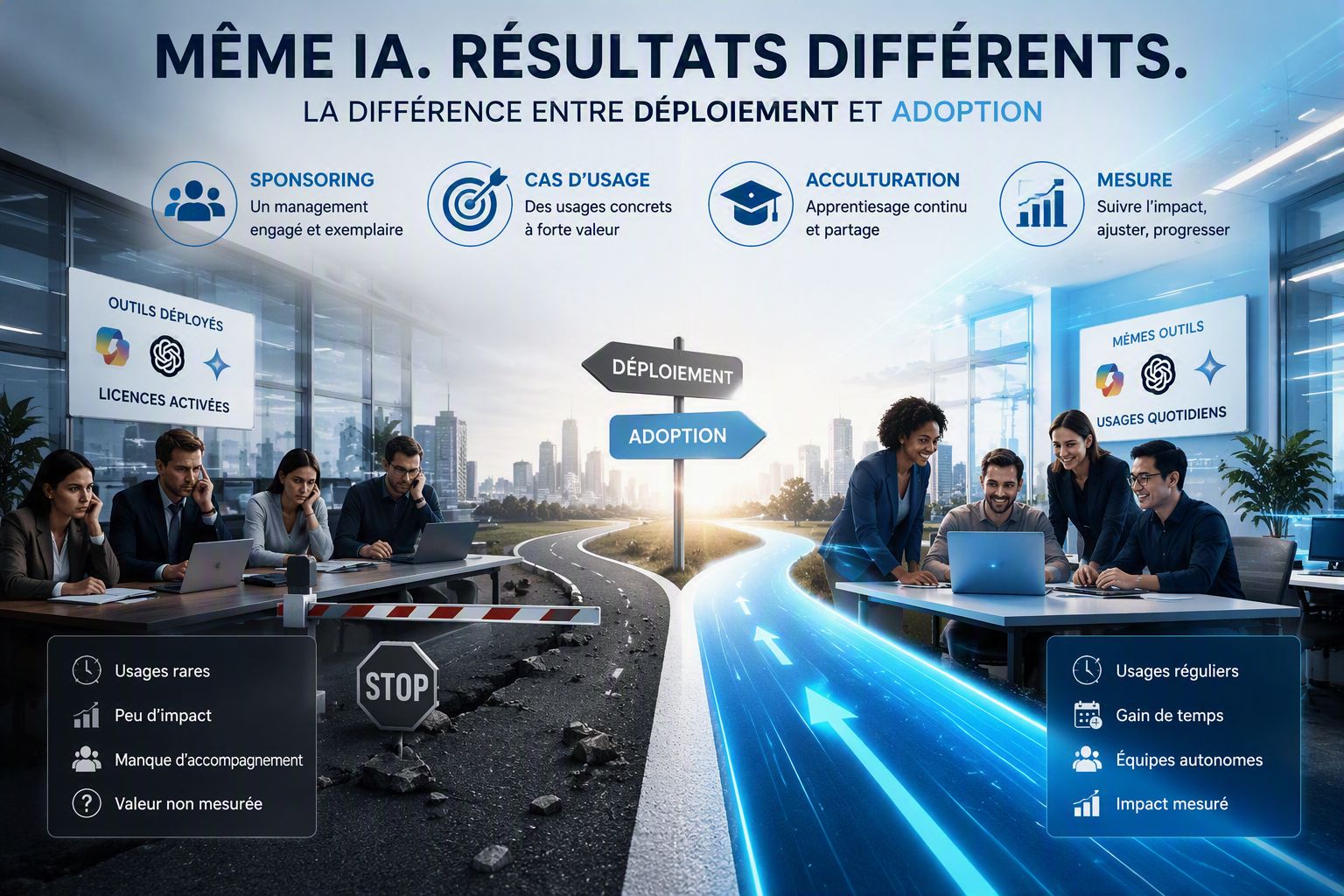
Why some teams save 5 hours a week with AI... and others nothing at all
When the first licenses for ChatGPT, Copilot, or Gemini are deployed in an organization, one expectation frequently arises:
"We are going to save time."
This expectation is legitimate.
Yet, a few months later, the results can vary significantly from one team to another.
Some have integrated AI into their daily routine:
- meeting preparation;
- document drafting;
- information retrieval;
- summaries;
- analyses.
Others continue to work as they did before.
Same tool.
Same company.
Same investment.
Radically different results.
Why?
Because there is a fundamental difference between deployment and adoption.
The illusion of deployment
In many organizations, an AI project is considered successful when:
- licenses are activated;
- users are trained;
- internal communication is completed.
But this only measures one thing:
Deployment.
Not value creation.
The equivalent would be assuming that a gym automatically improves physical fitness simply because it is open.
The reality is different.
Value does not come from access to tools.
It comes from their use.
First factor: sponsorship
The most successful initiatives almost always benefit from a visible sponsor.
Manager. Executive. Team leader.
Someone leads by example.
Someone tests.
Someone shares their learnings.
When employees see their manager using AI to prepare for a meeting, analyze a document, or save time on certain administrative tasks, adoption naturally accelerates.
Conversely, a project perceived as purely technological often remains confined to a few early adopters.
AI is a transformation topic.
Not just a tooling topic.
Second factor: use cases
One of the most frequent mistakes is starting with the tool.
The most advanced teams start with the problems.
For example, they identify:
- time-consuming tasks;
- repetitive research;
- recurring documents;
- low-value-added activities.
Then they evaluate how AI can help.
The difference is considerable.
A team that is simply asked to use Copilot will rarely use Copilot.
A team that is shown how to save 30 minutes on every sales preparation will quickly find it in their interest.
Usage creates adoption.
Not the other way around.
Third factor: acculturation
A one-off training session does not permanently transform practices.
The most mature organizations implement:
- regular workshops;
- sharing communities;
- ambassadors;
- feedback loops.
The best uses of AI often emerge from the employees themselves.
Learning then becomes collective.
This dynamic creates a momentum that one-off training sessions struggle to produce.
Fourth factor: measurement
This is often the most overlooked factor.
Many companies know how much they spend.
Few know how to measure the value produced.
Yet, a few simple questions are essential:
- Which use cases are actually developing?
- Who is regularly using the tools?
- What time savings are being observed?
- Which skills are progressing?
- Which departments are creating the most value?
Without measurement, decisions are based on impressions.
With appropriate indicators, it becomes possible to optimize usage, training, and investments.
This is, in fact, one of the challenges that a tool like the Digital Skills Analyzer can support when an organization wishes to track the evolution of skills and AI maturity.
What successful teams do differently
Teams that derive the most value from AI often share four characteristics:
✅ involved management
✅ clearly identified use cases
✅ a culture of continuous learning
✅ regular impact measurement
In other words:
They view AI as a human and organizational topic before making it a technological one.
A matter of transformation more than technology
AI is no longer really a matter of access to tools.
The tools exist.
The real challenge now lies elsewhere.
How to support employees?
How to develop skills?
How to measure the value created?
How to evolve practices?
Organizations that answer these questions will likely take a significant lead.
Not because they have more licenses.
But because they will know how to transform those licenses into usage.
And usage into results.
Conclusion
The difference between a team that saves several hours a week thanks to AI and a team that observes no impact is generally not explained by technology.
It is explained by adoption.
Sponsorship, use cases, acculturation, and measurement constitute the four most decisive levers for transforming an AI investment into sustainable value creation.
The question is therefore no longer:
Do you have an AI solution?
The question becomes:
Do you have the necessary conditions for it to be actually used?
At Pivotal Skills AI, we are convinced that the success of an AI project depends as much on skills and usage as on the technology itself.
And you, which factor seems most decisive to you today?