Back to news
AI training
AI skills
AI ROI
AI adoption

Why your AI investment will yield no ROI without a solid training plan.

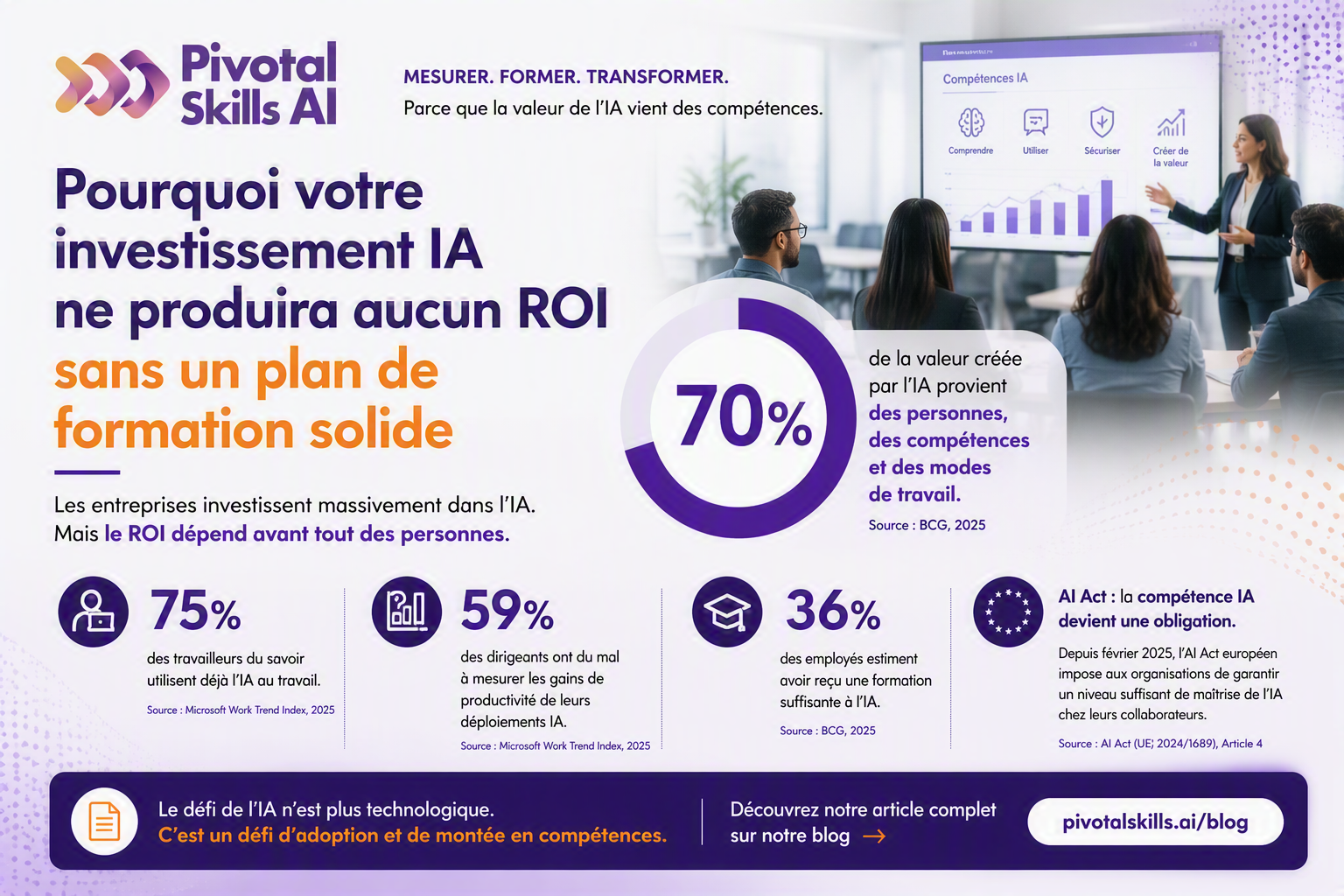
You are investing in AI. But are you actually getting any ROI? While companies are multiplying deployments of Copilot, ChatGPT Enterprise, and AI agents, value creation often remains difficult to demonstrate. Why? Because technology is only one part of the equation. According to BCG, 70% of the value created by AI comes from people, skills, and ways of working, while Microsoft finds that 59% of leaders still struggle to measure the ROI of their AI investments. The real challenge is no longer technological. It is human. ➡️ How do you measure AI skills? ➡️ How do you identify priority populations? ➡️ How do you transform adoption into measurable value? Read our full analysis on the Pivotal Skills AI blog.

Why your AI investment will yield no ROI without a solid training plan.

Un plan de formation solide en IA est crucial car l'absence de compétences freine l'adoption et le retour sur investissement des outils d'IA générative. Il permet d'assurer la maîtrise des usages, la conformité réglementaire (AI Act article 4) et peut augmenter l'efficacité des équipes jusqu'à 30% en optimisant l'utilisation des licences logicielles.

In 2026, most large companies have already invested in artificial intelligence.

Copilot licenses, conversational assistants, generative AI platforms, internal chatbots, process automation... Budgets are committed and expectations are high.

Yet, one question systematically recurs in executive committees:

"What ROI are we actually getting?"

The answer is often embarrassing.

Because deploying a technology is not the same as creating value.

The Myth of Automatic ROI

Many organizations have followed the same pattern:

✅ Purchasing licenses

✅ Technical deployment

✅ Internal communication

✅ A few enthusiastic demonstrations

Then...

❌ Employees who continue to work as before

❌ Irregular use of tools

❌ Usage limited to a few "power users"

❌ Difficulty in measuring real gains

The problem is not the AI.

The problem is thinking that adoption will naturally follow deployment.

No digital transformation has ever happened that way.

Why would it be any different with AI?

The Most Costly Gap: Skills

Generative AI does not just require new tools.

It demands new skills:

  • Knowing how to formulate effective prompts;
  • Understanding model limitations;
  • Verifying produced results;
  • Identifying the right use cases;
  • Integrating AI into existing processes;
  • Respecting security and compliance requirements.

When an employee masters these skills, value appears quickly.

When they do not, the tool remains underutilized.

And an unused license generates zero ROI.

Training is No Longer a "Nice to Have"

With the arrival of the European AI Act, the issue takes on a new dimension.

Article 4 of the regulation requires organizations to ensure that individuals using AI systems possess a sufficient level of AI literacy adapted to their role.

In other words:

Upskilling is no longer just a performance lever; it is also becoming a compliance requirement.

The companies that succeed will not necessarily be those that buy the most AI.

They will be those that help their employees use it intelligently.

Train Yes, But Train What?

There is a great temptation to offer identical training to everyone.

Yet, this is rarely effective.

A CFO, a salesperson, a legal counsel, or a developer have neither the same needs nor the same use cases.

Before launching massive training programs, a fundamental question deserves to be asked:

What is the actual AI maturity level of my teams today?

Without an answer to this question, the risk is simple:

Training everyone in the same way, at the same cost, for very different results.

What Distinguishes the Most Advanced Companies

The most mature organizations generally apply three principles:

  1. They measure skills before investing.
  2. They identify priority populations.
  3. They track adoption and impact over time.

They view AI training as a strategic investment rather than an awareness expense.

Because in the end, the real question is not:

"How much have we invested in AI?"

But rather:

"How much value are our employees capable of creating thanks to AI?"

And that answer always starts with skills.

💬 In your opinion, what is the main barrier to AI ROI in companies today: technology, usage, or skills?

Frequently asked questions

Pourquoi la formation en IA est-elle essentielle pour le retour sur investissement (ROI) des entreprises ?

La formation en IA est essentielle car sans compétences adéquates, les outils d'IA restent sous-utilisés, annulant le potentiel de ROI. Les entreprises qui investissent dans la formation de leurs collaborateurs s'assurent une meilleure adoption, une identification pertinente des cas d'usage et une intégration efficace de l'IA dans leurs processus, maximisant ainsi la valeur créée par leurs investissements technologiques.

Quelles sont les compétences clés que les collaborateurs doivent acquérir avec l'IA générative ?

Les collaborateurs doivent maîtriser la formulation de prompts efficaces, la compréhension des limites des modèles, la vérification des résultats produits, l'identification des cas d'usage pertinents, l'intégration de l'IA dans les flux de travail existants, et le respect des exigences de sécurité et de conformité.

En quoi l'AI Act européen impacte-t-il l'obligation de formation en IA des entreprises ?

L'AI Act européen, via son article 4, impose aux organisations de garantir que les utilisateurs de systèmes d'IA possèdent un niveau de compétences suffisant et adapté à leur rôle. La formation devient donc non seulement un levier de performance, mais aussi un enjeu de conformité réglementaire, essentiel pour éviter les sanctions et assurer une utilisation responsable de l'IA.

Comment une entreprise doit-elle concevoir son plan de formation IA pour être efficace ?

Pour une efficacité maximale, un plan de formation IA doit être basé sur une évaluation préalable des compétences existantes des équipes, l'identification des populations prioritaires selon leurs besoins et usages spécifiques (ex: financier vs développeur), et un suivi continu de l'adoption et de l'impact des outils. Cela évite les formations génériques et coûteuses pour des résultats hétérogènes.

Quels sont les risques d'une approche « acheter des licences et déployer » sans formation en IA ?

Une approche sans formation conduit souvent à une sous-utilisation des outils, des collaborateurs qui maintiennent leurs anciennes méthodes de travail, une adoption limitée à quelques « power users » et une difficulté à mesurer les gains réels. En conséquence, les licences restent sous-exploitées et le ROI attendu des investissements en IA n'est pas atteint.